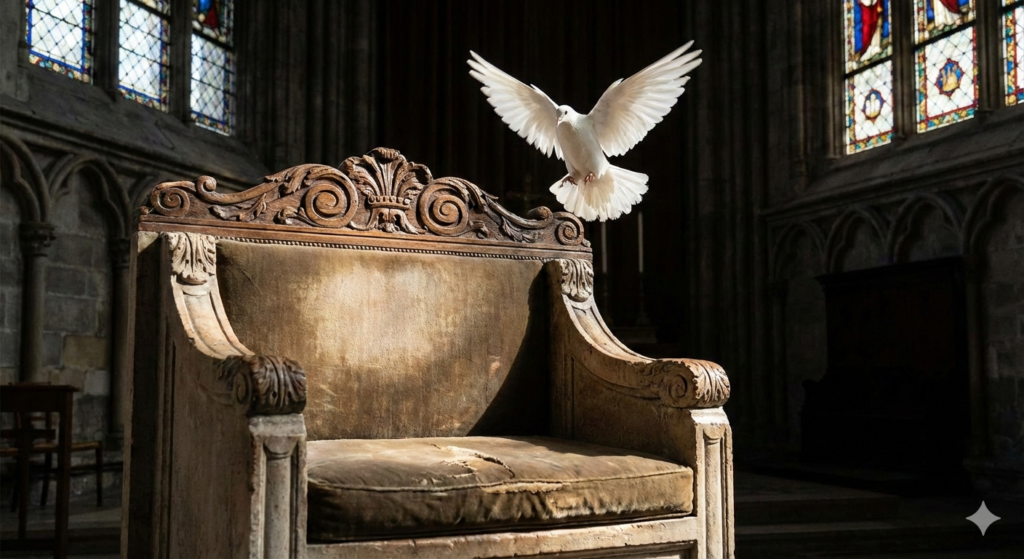
Waiting with Stones

Every Christian faces tests that challenge their faith. When we encounter these trials, we often ask ourselves: Is there really an answer to my problem? Will God truly provide?

While the Bible confirms God’s desire to care for us, His answers rarely arrive overnight. Often, the breakthrough happens when we least expect it or much later than we hoped. However, we can take heart knowing that God is never too late.

What is Biblical Faith?

Hebrews 11:1 tells us, “Now faith is the substance of things hoped for, the evidence of things not seen.” In other words, faith is having a deep-seated confidence in what we hope for and a certainty about things we cannot yet see. Faith is the confidence that God will do what He promised in the future.

Even as we wait, God invites us to rejoice. True conviction means celebrating the promise as if we already possess it, even while it remains unseen.

Trusting God’s Creative Power

I remember a time when I was frustrated while waiting for my future wife. During that season, a verse about John the Baptist came to mind. He told the Pharisees that God could raise up “sons of Abraham from stones” (Matthew 3:9).

Intellectually, I knew that God could do ANYTHING. But when this verse walked into my consciousness, it declared that even though I didn’t know where my wife was coming from, God was able and willing to create something very special [i.e. a son of Abraham, born to special rights and privilege] from a STONE. This revelation blew me away!

I realized that if God can create life from a stone, He could certainly provide for my future. My only job was to wait.

Guarding Your Soul During Uncertainty

In Luke 21:19, Jesus says, “In your patience, possess ye your souls.” The soul—the seat of our mind, will, and emotions—is where worry and anxiety often take root.

When facing loss or sickness, it is easy to lose heart. In Psalm 42:5, the psalmist asks a vital question: “Why are you cast down, O my soul? And why are you disquieted within me?” When you feel this way, try “speaking” to your soul: remind your emotions of God’s character and the truth of His promises, choosing to anchor yourself in His Word rather than your feelings.

We must ask ourselves this same question. If God’s promises are “Yes and Amen” (2 Corinthians 1:20), why do we let doubt overshadow His Word? The “work of God” is simply to believe in Him (John 6:29), regardless of what the physical world says.

The Power of the “Wait” (Qavah)

We often hate waiting because it makes us feel vulnerable. However, the Hebrew word for wait, qavah, suggests something much deeper than just sitting around.

As Isaiah 40:31 promises, “They that wait upon the Lord shall renew their strength.” Waiting is an active part of our spiritual walk. When we seek Him during the delay, we are promised that we will never be put to shame.

Clearly one simply needs to do a word study to find these valuable reminders:

  • Psalm 25:3
  • Psalm 27:14
  • Psalm 37:9
  • Psalm 130:5
  • Lamentations 3:25

These verses show that waiting [and seeking Him] are keen parts of our walk. if you are in a season of waiting, remember: those who hope in Him will never be disappointed.

If you have grown tired of waiting, leave a comment in the comments section. I will answer as soon as I can!

Leave a Reply

Your email address will not be published. Required fields are marked *

Gethsemane’s Test

The holiday season that spans from the birth of Christ to His resurrection offers a unique opportunity for “live discussions” about the core of our faith. It is a time for deep conversations with children and seekers alike about why He came, how He lived, and why He died.

A local church Christmas play recently posed a fascinating question: “Why didn’t Jesus come as a Ninja superhero?” To understand the answer, we must look past the “titular” roles of a deity and examine the profound mystery of the Hypostatic Union: Christ as fully God and fully man.


A Voluntary Sacrifice: “I Lay Down My Life”

A common misconception is that Christ was a victim of circumstance or a crime. However, the Bible is clear that His death was a legal payment for a “sin debt” that humanity could not pay.

As a sinless man, Jesus was not subject to death as we are. He had no sin to make Him liable for the grave. Therefore, His death was a deliberate choice. In John 10:17-18, He declares:

“I lay down my life… no man taketh it from me.”

His sacrifice was not the act of someone being killed; it was the act of a King laying down His authority to ransom His people.


The Gethsemane Struggle: Surrendering the Will

Before the cross came the garden. In Gethsemane, we see the humanity of Christ in its most relatable state: reluctant, struggling, and seeking another way.

The Preparation

Jesus had been preparing for this moment for some time. At the Transfiguration, he received counsel from Moses and Elijah regarding His “departure” (the Greek word used is exodos). Even with this heavenly counsel, the weight of the task was immense.

The Decision

In Mark 14:36, Jesus asks the Father if the suffering can be removed, yet He concludes with the ultimate act of leadership:

“…nevertheless, not what I will, but what thou wilt.”

Jesus leads in a way we often fail to imagine—by giving up His will. This is a level of insight and submission that goes against human nature, yet it is the very thing that secures our freedom.


Soul Restoration: Mind, Will, and Emotions

Biblical salvation is not just a ticket to heaven; it is the restoration of the soul. According to Scripture, the soul consists of three primary components: the mind, the will, and the emotions.

To be truly transformed, these three areas must be sacrificially given back to God:

  1. The Mind: We are told we have the “mind of Christ” (1 Cor. 2:16) and must renew our thinking.
  2. The Emotions: We develop the compassion of Christ as we are changed into His likeness.
  3. The Will: Just as Christ did in Gethsemane, we must forfeit our own will to complete the restoration of our souls (Psalm 23:3).

The Passion of Surrender

What happened in Gethsemane was the ultimate example of “Passion.” It wasn’t just about the physical suffering of the body, but the total surrender of His everything for us.

By observing His surrender, we find the roadmap for our own lives. We aren’t called to be superheroes; we are called to be submitted, allowing our minds, wills, and emotions to be redeemed by the one who gave up His own for our sake.

_______________________________________________________________________________

“Which part of the soul—the mind, the will, or the emotions—do you find the hardest to surrender to the Prince of Peace? Share your thoughts in the comments below.”

Peace of the Prince: Finding Biblical Rest in a Distracted World

As we enter early December, the air is filled with the familiar lyrics of Handel’s Messiah and the prophetic words of Isaiah 9:6: “Wonderful, Counselor, The Mighty God, the Everlasting Father, the Prince of Peace.” But in a world filled with “absolute distractions”—wars, rumors of wars, and constant threats to our well-being—how does Christ actually enact His role as the Prince of Peace? How do we access a peace that is not just a feeling, but a fortified state of being?


What Does “Prince of Peace” Mean?

The title “Prince of Peace” (Hebrew: Sar Shalom) describes more than a quiet disposition. It defines a ruler whose authority establishes wholeness and order.

According to the renowned commentator Matthew Henry, Christ earns this title through His righteousness:

“He was king of Salem, that is, king of peace; first king of righteousness, and after that king of peace. So is our Lord Jesus; he by his righteousness made peace… Christ speaks peace, creates peace, is our peace-maker.”

The Distinction Between Two Types of Peace

Worldly PeaceThe Peace of Christ
Dependent on favorable circumstances.Operates regardless of external trials.
Fragile and easily disturbed by news.A “supernatural gift” that transcends understanding.
Passive (the absence of conflict).Active (the presence of a Garrison).

How Christ Enacts His Peace: The “Garrison” of the Heart

In Philippians 4:6-7, the Apostle Paul provides the technical “blueprints” for how this supernatural peace functions. While the world tempts us toward anxiety, the Amplified Version (AMP) reveals a deeper meaning in the original Greek:

“And God’s peace… which transcends all understanding shall garrison and mount guard over your hearts and minds in Christ Jesus.”

An Active Defense System

This action is not passive; it is an ongoing military-grade protection for your internal life.

  • It Fortifies: It builds a wall around your soul (mind, will & emotions)
  • It Keeps Watch: It monitors your thoughts (the mind) to prevent “distractions” from taking root.
  • It Adapts: As an “Anointed Overcomer,” His peace adjusts to the specific trials and tribulations you face today.

Entering the Promised Rest: The “Finished Work”

A key to resting in the Prince of Peace is submitting to His Kingship and exercising faith in His “Finished Work.”

In Hebrews 4, we see that Christ, after purging the sins of mankind, sat down. In the biblical context, “sitting” indicates that the work is complete.

  • Christ’s Rest: He sits at rest, waiting for His enemies to be placed under His feet.
  • Our Rest: Because He has already won the victory, we are invited to “cease from our own works.” We no longer have to worry about our legacy or our future because our King has already secured them.

Holding Fast in December

The “Good News” is that we are free from the torments of modern anxiety. By submitting to the Kingship of Christ, we receive a commodity found nowhere else: a peace that does not ignore the storm but stands guard through it.

The Key takeaway: We don’t have to produce peace; we simply have to hold fast to the one who is Peace.

“We often think of peace as the absence of conflict. How does the idea of peace as a ‘garrison’ change your perspective today? Add your comment in the comment section”

He wept over it

Enrique Simonet - Flevit super illam 1892

Painting by Enrique Simonet Lombardo {{PD-1996}} Public domain, via Wikimedia Commons

We were able to visit the world famous Prado Museum and yes, we waited for the free visit hours in a line for a while before we were let in. Now that everyone is carrying a camera at all times, all the visitors were compelled to comply with rule forbidding photography. I was excited but I wasn’t sure what to expect.

My wife and I wandered the rooms and halls knowing we couldn’t view everything, but relishing the incredible timeless paintings and sculpture. The Prado holds artwork from Spain’s own Goya as well as Rubens, Rafael and even Rembrandt.

The Painting

After walking through several rooms, I walked through one door way and my heart fell. Most of the gallery rooms are quite large and one of the main areas is literally several hundred feet long. I was entering one room when I saw the painting.

Previous visits to museums taught me that there is an optimal distance for viewing paintings. No painting [that I am aware of ] is meant to be viewed up close. One needs perspective to see the depth, shading and detail added by the artist.

This painting measures 18 feet by 10 feet high! Upon entering the room I was immediately entranced into the captured moment. I knew it was Christ and His disciples gazing over Jerusalem. I was then compelled to know what moment the artist had captured.

I assumed that the artist had chosen Matthew 23:37 “O Jerusalem, Jerusalem, thou that killest the prophets, and stonest them which are sent unto thee, how often would I have gathered thy children together, even as a hen gathereth her chickens under her wings, and ye would not!” [KJV]

That was not it.

For me the sense of sorrow was pervasive as the color of the sky helped deliver the tone and accented how He expressed his sorrow. It was as if the turmoil Jerusalem would experience was revealed to him at that moment.

Luke 19:41

In my mind, this was the time for the Matthew 23:37 speech, but according to some scholars, his admonishment for Jerusalem only came after entering the city. The artist cites Luke 19:41 as the inspiration which took place during the approach to the city known as the “Palm Sunday parade”.

One commentator declares that Jesus must have repeated some ideas on different occasions. It seems that all of this speech could have been shared in one extended reveal of Jerusalem’s future fate.

All of this cannot be allowed to overshadow the fact that Jesus, architect, creator & ruler of creation was moved to tears by compassion on the fate of the city. He gifted Simonet with a glimpse of his ongoing passion.

Freedom for the Jailer


My Dungeons Shook is a James Baldwin essay dedicated to his namesake nephew. A recurring theme in Diasporic literature has an elder providing advice e.g. sage wisdom to a protégé that informs descent into manhood. Earlier versions in this genre include the book of Proverbs written by Solomon to his son.

Another modern and particularly popular iteration was written by Ta Nahisi Coates sharing his anxiety of living in these United States with his son. Freedom for the Jailer is dedicated to relatives that I would share with understanding that mothers and grandmothers already talk with girls and boys, warning them that they must be smart about problems that causes trouble. Because bad trouble could lead to jail.

Jail is where no one wants to land because not only will you be locked up, but your dreams will be locked up with you. Strange things happen in jail and no Black man can afford the risk of long-term incarceration. The jailers just don’t care.

One jailer that didn’t care had the tables turned. One night after midnight, an earthquake opened the doors to the jail and broke the chains. Sworn to duty, the jailer almost took his life as he assumed the prisoners had escaped. The prisoner named Paul shouted “We’re here, do no harm!”

The jailer took the prisoner to his home and received Christ that night. The jailer was freed.

Black people have been jailed for 400 years. The jailer must be freed so we can be freed. Sons, grandsons and friends: Here are five concepts that will support your successful career, better your life and keep you free.

i] We were always taught that Education was key to success in America. Betty Hayes went to her grave believing that the opportunity to move up was bound to being better prepared. Education is life giving. One learns and even what he doesn’t know gets revealed as he continues to learn.

Unfortunately, decades into the 21st century, the workplace and economy conceded the need for both academic and skill-based education for workplace success. Market forces have not managed to bring down the cost of a college education. This is a spurious combination in the light of falling demand as a result of the fear of long-term debt and layoffs of college-educated middle management in many sectors.

ii] The second tenet certainly falls in tandem with the first. Reflect on this statement: Hard work is an emblem to those around you. Humility is an emblem to God. Today there is constant temptation to cut corners and to take the ‘easy’ route. Those around you are influenced by your example. They will take cues from your performance. The Lord will give you favor to lead.

The world has grown comfortable with those who bully others and steamroll themselves to the top. Paul’s advice about leadership explains it well. A leader must be well-thought-of, committed to his wife, cool and collected, accessible, and hospitable. He must know what he’s talking about, not be overfond of wine, not pushy but gentle, not thin-skinned, not money-hungry. He must handle his own affairs well, attentive to his own children and having their respect.

[I Tim. 3:2-4 MSG]

iii] Charity begins with you, sharing with and loving on others with no expectation of return. The entire earth is the Lord’s and everything in it (which includes all of your little stuff too). There’s no need to hoard. The love of God is free. God is love.

iv] Your closest friend will let you down. Jesus never will.

This includes your wife; cherish her anyway. The better you know Jesus, the less likely you will feel disappointed. Spend time with him.


v] Learn the value and virtue of patience. Especially with yourself. Everyone has trials and various kinds of drama, but will you outlast it? “. . . trouble don’t last always” Will you demeanor and temperament be an example to peers and co-workers? Are you mindful that the Lord is always watching?


The Rhema Word vs. Exposed Reality

The Word of God is alive; sharper than a two-edged sword but is it really true?What is truth?Is the Bible really relevant?What do you believe – what are you willing to believe?Jonah and the whale? [This must be a biblical fairy tale]

Dinosaurs – they’re not really in the Bible, so where do they fit?Tithing [do you actually believe that God will meet all of your needs if you give Him the first 10 percent of your money?]God’s provision for healing – we know He can, but will He?Spanking and corporal punishment [it’s in the Bible but it can’t be true –can it?]Homosexuality [man-made or affliction?]There are so many dissenting words and diverse meanings in the world. People who say that they are Christians, religious, spiritual but they seem just as if not more confused than we are. Yet another sign that these are the last days – as Paul said there would be people who “have a form of godliness but deny the power thereof” [II Tim 3:5]Translations, canonical

“I believe the Bible but there are some parts that I don’t understand – there must have been something wrong in the translation”.I have a problem understanding people whose concept is so limited that the Almighty God of Hosts couldn’t make a way for His indelible word to be recorded and available for the entire world, to those who want it.We must remember I Corinthians 2:14 “. . the natural man receiveth not the things of the Spirit of God; for they are foolishness unto him: neither can he know them because they are spiritually discerned.”You may need to do a self-check; if you are having such difficulty with believing – It has been said that some Christians believe that the bible is inspired in spots, some spots are inspired by God and others are just wrong.If you have never taken a language course, especially Aramaic, Greek or Hebrew [the biblical languages] you might need to do so and find out not only the intricacy of the languages, but the clarity of the best known translations. One needs to be very clear that while there may be some difference in the nuance of how a phrase is rendered. There is very little difference between one translation and another in what is literally meant, especially in the exegetical light of historical context.This is a Faith FightUnfortunately, the less you know – the better it is for our adversary, who needs us to be ignorant to our rights, responsibilities and privileges as believers and heirs to the Kingdom. If you remain skeptical about the power of God’s word and its efficacy to assist and to conduct warfare – you will remain powerless.My one-word synonym for faith is “conviction”. Are you convinced that God can do what He says He will do? Are you convinced that His word is literally true? Do you think that He made promises for poetic value? Have you put God in a box?The writer of Hebrews states that “The word preached did not profit them, not being mixed with faith in them that heard it” [4:2]The word will only be profitable for us but it can only be if we place faith in it – if we are convinced that God’s word is alive [rendered quick in Heb. 4:12 ];

  • enduring [“But the word of the Lord will last forever” – I Pet. 1:25];
  • and powerful [“He sent his word and healed them and delivered them from all of their destructions” – Psa. 107:20]

In John 6:29, Jesus states “This is the work of God, that you believe on him whom he has sent” That is, believe that He is Messiah and ergo, believe in the intrinsic value of the work he performed while on earth. The trick [if you will] of the work is to remain convinced [without regard to circumstance]. This is more difficult than it sounds. Take for example: The Israelites when they left Egypt, they had just witnessed a great deliverance. They experienced the catastrophe of the Passover and the duress that the Egyptians felt as their sons and livestock died. They left Egypt and faced the first hurdle i.e. The Red Sea. They were ready to go back to Egypt.The Apostle Paul states: “Fight the good fight of faith, lay hold of eternal life” Although spiritually you will try to keep your faith, the nature of the fight continually works to shake your faith and confidence in the promises of God. The circumstances and appearances all work against faith but you have to know what you know. The substance of things hoped for, the evidence of things not seen.To continue with this metaphor, we are in a fight using the weapons(s) given for the fight. The breastplate of righteousness, feet shod with the preparation of the gospel of peace, the helmet of salvation, loins gird with the truth, above all with the shield of faith.To open this up even more we need to understand:1] All items mentioned are defensive armamentNotice how the armor of God is used, the inner most garment is the truth.Jesus said “And you shall know the truth and the truth shall make you free” John 8:32A fighter who cannot get solid traction will surely get knocked out! The traction is the preparation of the good news of God’s peace with man. Above all using the shield of faith – your key defensive weapon because it’s a fight, a faith fight!!2] The only offensive weapon is the swordThe word of God is a sword, but not the leather and paper – the word that can be used as a weapon is the word that you have embedded in your heart. How is the word of God used? Mt. 4:4, 4:7, 4:10Jesus said, “heaven and earth will pass away but my word will not pass away” Mk. 13:31Reality exposed says that the word of God is real and true.